

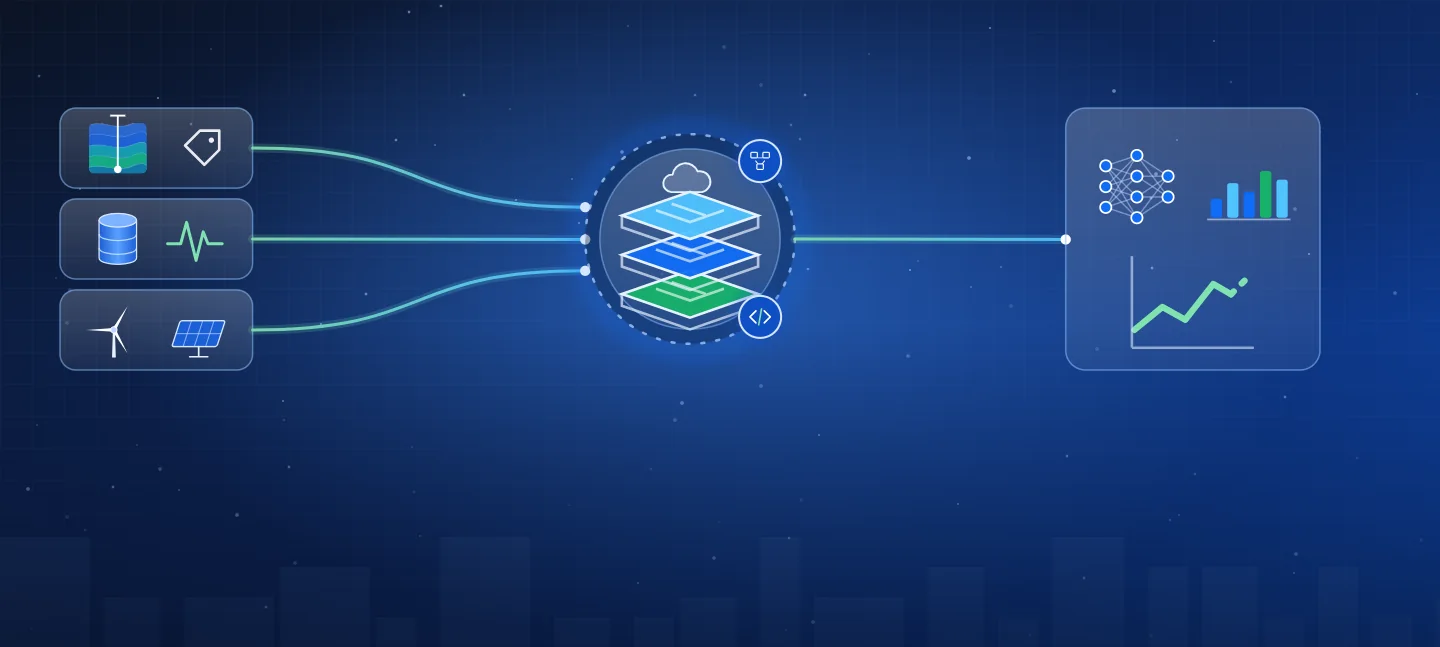
Energy companies generate large amounts of data across subsurface, operational and renewable domains. The OSDU Data Platform offers a unified, cloud-native way to standardize and manage that data, which makes it a foundation for modern digital operations.
1. What Is OSDU and Why It Matters for Energy Data Management?
The OSDU Data Platform is an open, vendor-neutral platform built to harmonize energy data from multiple sources. It removes siloed datasets and inconsistent formats, which improves access, transparency and real-time decision-making.
To learn more about the official vision behind OSDU, visit the OSDU Forum at https://osduforum.org/
2. Key Advantages of the OSDU Data Platform for Energy Companies
2.1. Standardization Through the OSDU Data Platform
OSDU provides:
- A unified data schema
- Standard APIs
- Metadata-driven structure
That suits companies that manage subsurface, SCADA, IoT and renewable energy data.
3. Real-Time Insights Powered by Clean, Trusted OSDU Data
Data that flows through OSDU becomes more reliable, structured and analytics-ready.
Energy companies can then:
- Improve production forecasting
- Optimize energy output across assets
- Monitor equipment health in real time
- Enhance predictive maintenance models
- Accelerate renewable energy forecasting
Removing inconsistencies and mismatched formats gives decision systems the trusted data foundation they need.
4. OSDU as the Ideal Foundation for AI and Advanced Analytics
Modern energy operations rely heavily on AI and machine learning.
From predictive maintenance to anomaly detection and power curve optimization, AI models require:
- Harmonized data
- Clear schemas
- Metadata-rich datasets
- Traceability and version control
The OSDU Data Platform provides all four. Its structured format and standardized API access let data scientists build and deploy AI models faster and more accurately.
5. Reducing Operational Costs Through a Unified Data Strategy
OSDU helps companies lower costs by transforming how data is stored and shared:
- Eliminates redundant data copies
- Reduces custom ETL pipelines
- Minimizes long-term storage requirements
- Lowers integration and maintenance costs
By centralizing information in a vendor-neutral environment, the OSDU Data Platform dramatically reduces Total Cost of Ownership (TCO) across the entire digital ecosystem.
6. Enabling Energy Transition Through Scalable, Multi-Energy Data Integration
Energy companies are rapidly expanding their portfolios to include:
- Wind farms
- Solar plants
- Geothermal systems
- Battery storage
- Hydrogen projects
Traditional data architectures struggle with this diversity. OSDU supports multi-energy data integration natively.
This makes it easier for operators to build a unified view of production, performance and sustainability metrics.
7. A Global Standard Supported by the Largest Players in Energy
The strength of the OSDU Data Platform lies not only in its architecture but also in its ecosystem.
OSDU is supported and adopted by global leaders including:
- Shell
- BP
- Equinor
- SLB (Schlumberger)
- Microsoft Azure
- AWS
- Google Cloud
Conclusion: What OSDU Offers Energy Companies
The energy sector needs systems that are scalable, interoperable and analytics-driven.
OSDU's open standards and cloud-native architecture are built to provide that.
By adopting the OSDU Data Platform, energy companies gain:
- A unified data environment
- Lower operational and IT costs
- Improved analytics and AI readiness
- Faster digital transformation
- An architecture ready for multi-energy portfolios
As platforms like EvoNex Pro integrate seamlessly with OSDU, the value multiplies—unlocking real-time intelligence across every asset in the energy chain.